Mahjong Triple 3D - Tile Match
- 4.8
- Rating
- 10.00M
- Installs
- Free
- Price

 Analysis by App-foxy
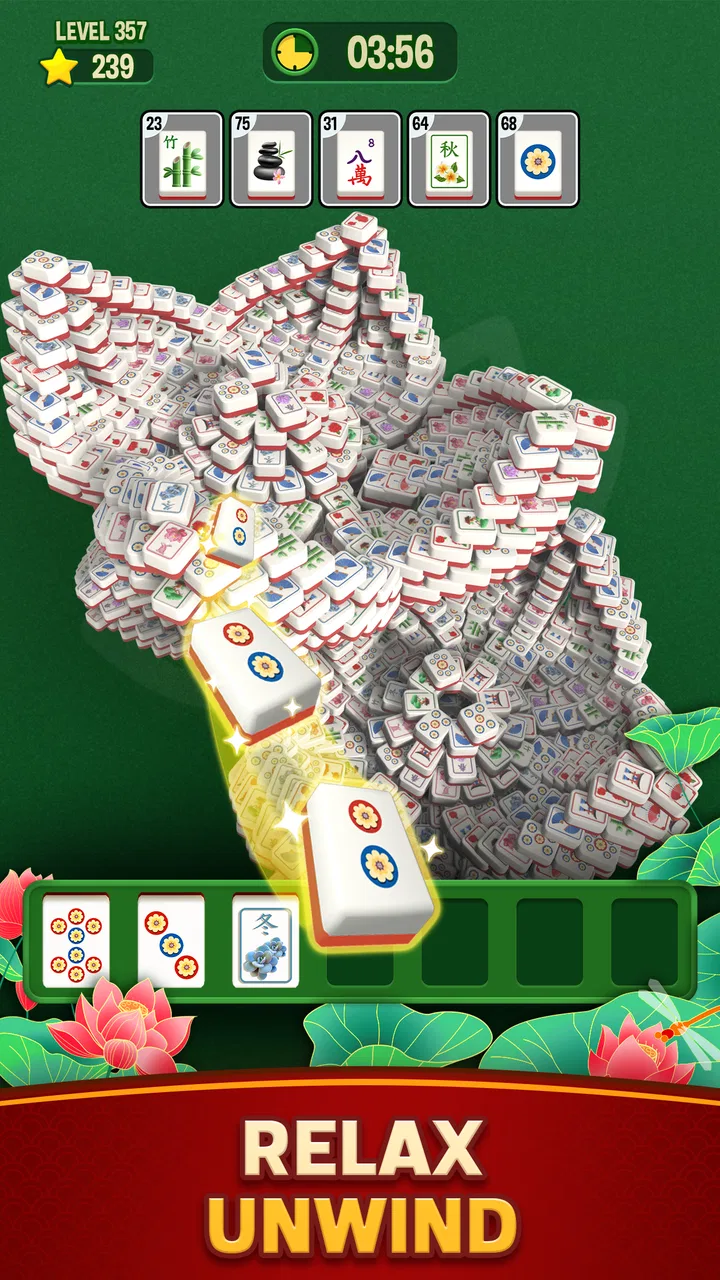
I picked up Mahjong Triple 3D - Tile Match expecting a simple way to fill a few spare minutes, and that is still where it makes the most sense to me. It is a free board game from LIHUHU PTE. LTD. built around matching three identical three-dimensional tiles. The presentation is gentle rather than competitive, so it feels closer to a quiet sorting exercise than to a traditional mahjong table.
That distinction matters. This is not the classic four-player mahjong game, and it does not ask you to learn traditional hands, scoring, or turn order. Instead, I look for exposed matching tiles, select a set of three, and gradually clear the arrangement. The basic idea is easy to understand, but the raised tile layout gives it more visual depth than a flat match-three board. I found it especially comfortable when I wanted something active enough to hold my attention without demanding a long, uninterrupted session.
The game has reached a 4.7 average from around 69 thousand ratings, with more than 10 million installs. Those figures suggest that its relaxed matching format has found a broad audience, but they do not make it automatically suitable for everyone. My experience is that its appeal depends on whether you enjoy careful observation and small decisions more than fast action or deep strategy.
You May Also Like

 Blood Strike: 2.5 Anniversary
Blood Strike’s Loadouts Turn Every Drop Into a Tactical Gamble
A close look at Blood Strike’s custom loadouts: how fast access to signature weapons reshapes its battle royale rhythm, rewards preparation, and narrows the gap between fights.

 Pandora - Music & Podcasts
Pandora’s Music Is Easy to Start, but Harder to Recover
Pandora’s strength is its low-effort path from a seed to a station. Its weak spot is how much confidence it asks you to place in connection, setup, and quiet recovery.

 8 Ball Pool
 Is Built on Rivalries, Rematches, and Routine
A close look at the rivalries, rematches, shared routines, and unanswered safety questions that turn a quick pool match into a persistent mobile community.

 Samsung Music
’s Quiet Strength Is Playing What You Already Own
Its reach comes less from spectacle than from dependable access to a personal library. That simplicity is both the app’s strongest retention engine and its ceiling.

 AccuWeather: Weather Radar
AccuWeather Review: A Quick, Clear Forecast for Everyday Decisions
For everyday plans, the best forecast is the one you can understand quickly. AccuWeather makes rain timing, radar, and local conditions easy to act on, with a few trade-offs.

 Hill Climb Racing
Why Hill Climb Racing Still Turns Crashes Into One More Run
A tiny car, a bumpy hill and one more upgrade: Hill Climb Racing keeps resurfacing because its simple chaos makes every near-miss feel personal.
More From Our News Desk
View All News


How it fits into a shared household
The most natural household use is informal: one person leaves the phone or tablet on a table, plays a short round, and another person picks it up later. I can imagine using it while waiting for dinner, during a quiet break, or when a family member is nearby but nobody wants to start a full multiplayer game. The board is visually understandable enough that someone watching can follow the immediate goal without needing a tutorial.
That makes it a better shared-device title than many games that depend on a personal account, a long campaign, or a complicated control scheme. A parent, partner, or older relative can hand over the device and explain the central action in a few seconds: find three matching tiles and place them in the available tray. The interaction is tactile and direct, which reduces the learning barrier.
Still, sharing the device does not turn it into a cooperative game. I did not treat it as a two-person puzzle where both players can make moves at the same time. The household value comes from taking turns informally, discussing which group to remove, or simply letting someone else have a go. If you want a game that records separate progress for every person using the same phone, you should think carefully before making it a family activity. The safest approach is to let one person remain the main player and use occasional handoffs for casual turns.
A realistic example is a short evening session with a child watching beside an adult. The adult can make the first few choices, explain why removing one visible group may reveal another, and then pass over the phone for a turn. That works well as light coordination, but I would not describe it as an educational activity or a substitute for a dedicated family board game. Its strength is its low-pressure rhythm, not structured teamwork.
What the first session feels like
Getting started is straightforward because the central rule is immediately visible. I do not need to memorize a card set or understand a fictional world before making progress. The three-dimensional arrangement gives every board a small visual puzzle: some tiles are easy to spot, while others are partly obscured by the stack around them.
My first useful habit was to pause before tapping. It is tempting to select the first matching group I notice, but the available tray can become awkward if I remove tiles without considering what may be uncovered next. I get better results by scanning the whole board, identifying several possible triples, and choosing the move that keeps future options open. That small change turns the game from random tapping into a more deliberate observation exercise.
This is also where the game differs from a conventional flat match-three title. In a standard grid, I usually think about adjacent swaps, chains, or board-wide combinations. Here, I think in terms of visibility, grouping, and order. The important question is not only “which three match?” but also “which removal exposes useful tiles without filling the holding space too quickly?” That extra layer is modest, yet it gives the otherwise simple format enough texture for repeated short sessions.
Boundaries for phones used by more than one person
Because the game is free to download, it is easy to install on a shared device without making a purchase decision first. The age classification is Everyone, which suits the calm visual concept and accessible controls. Even so, an age label should not replace ordinary household supervision. I would still show younger players how to pause, avoid accidental taps, and ask before interacting with any purchase prompt.
The game includes in-app purchases ranging from $1.99 to $99.99 per item. That is the most important boundary for a shared phone or tablet. I would not hand the device to a child with unrestricted purchasing access, and I would make sure the household understands who is allowed to approve spending. The game itself may feel harmless and casual, but a free download can still include paid options, so the device owner should manage that part rather than leaving it to chance.
I also prefer to establish a simple rule about turns: finish the current board before passing the device, unless everyone agrees otherwise. Since this is a single-player board experience, abruptly switching between people can make it difficult to remember which possible groups were being considered. That is a small issue, but it matters when several people are sharing one screen and each person wants to make the next move.
Another practical boundary is attention. The peaceful style can make the game feel like background relaxation, but the visual matching still requires concentration. I would not use it while walking, crossing a road, or doing anything that needs full awareness. For a shared household, it works best in a settled place where the device can be passed safely and nobody is pressured to play quickly.
Coordinating turns without turning it into a competition
One feature of the format that I appreciate is how naturally it supports conversation. A second person can point out a possible triple, question the order of a move, or suggest waiting before removing a tile. That creates a small shared puzzle without requiring the app to provide a multiplayer mode. In my experience, this is more enjoyable when the players treat suggestions as ideas rather than commands.
There is a trade-off, though. A person who is more observant may start making every decision, leaving the other player to tap only when told. To keep the activity balanced, I would give each person responsibility for a complete choice: one player scans the left side of the arrangement, the other scans the right, and the person whose turn it is decides which triple to remove. This is not an official rule, just a useful household routine for keeping both people involved.
The game is also suitable for a quiet individual routine. I often find that the best session is not the longest one. A few boards during a break can provide a clear stopping point, while continuing after a difficult board may turn relaxation into irritation. If I feel myself tapping too quickly or overlooking obvious groups, I take that as a sign to stop rather than forcing progress.
Compared with a classic board game on the table, this format is faster to set up and easier to reset, but it offers less social depth. A physical mahjong set, a matching card game, or a traditional tile game gives everyone visible pieces and a stronger sense of shared ownership. Mahjong Triple 3D is preferable when convenience matters and the household wants something immediately playable on one screen. It is not the better choice for a group seeking negotiation, bluffing, or a proper head-to-head contest.
Age, trust, and the limits of the peaceful presentation
The Everyone rating matches my impression of the core activity: there is no need for mature themes to understand or enjoy the tile matching. The calm design also makes it less intimidating for people who avoid action games or complicated strategy titles. An older family member who is comfortable with basic touch controls may find the visual grouping more approachable than a game filled with timers, characters, or dense menus.
Even with that accessible presentation, I would separate “appropriate to understand” from “appropriate to play without guidance.” Younger users may recognize matching quickly but still tap paid options or hand the device to someone else without realizing that progress belongs to the same player. The household should decide who owns the game session and who can approve purchases before sharing the device.
Trust is relevant for adults as well. If several people use one phone, the main player should be comfortable with others seeing the current board and interacting with it. I would not treat a shared session as private progress. The simplest arrangement is to keep the game associated with the device owner’s normal use and avoid promising separate histories or personal boundaries that the game may not provide.
The developer is LIHUHU PTE. LTD., and the current version is 2.9.0. The game runs on Android 7.0 or later, so compatibility is reasonably broad for older Android devices that still meet that requirement. Before installing on a household tablet, I would check the operating system first and leave enough room for normal app updates. That is a more useful preparation step than assuming every older phone will handle it simply because the game looks visually simple.
Small techniques that improve the experience
My first practical tip is to use a two-pass scan. On the first pass, I look only for fully visible triples. On the second, I inspect partially covered tiles and ask which removal is most likely to expose them. This prevents me from spending the holding space on an attractive match that blocks better options later. It is a subtle adjustment, but it makes the three-dimensional layout feel much more manageable.
My second tip is to treat the tray as a planning resource rather than a place to collect anything that looks useful. When only one or two matching tiles are visible, I consider whether taking them now will leave an awkward single tile behind. Sometimes the correct move is to clear a complete group elsewhere first. This is the point at which the game rewards patience more than speed.
My third tip is especially useful on a shared screen: have the observer name the three symbols before the player taps. That creates a quick confirmation step and reduces accidental selections when several similar designs are close together. It also gives a child or less experienced player a chance to practice visual comparison without taking over the entire board.
A fourth trade-off is screen size. On a larger tablet, the raised arrangement is easier to inspect and discuss with another person, but the device may be less convenient for a quick solo session. On a phone, the game is easier to carry and pick up for a moment, although crowded tile layouts can require more careful tapping. I would choose the device based on who is playing: a solo commuter may prefer the phone, while a shared household session benefits from a larger display.
Finally, I recommend deciding in advance what “done” means. If the aim is relaxation, stopping after a board or two is sensible. If the aim is improving observation, the player can focus on avoiding rushed choices rather than chasing an endless session. The game’s gentle presentation makes it easy to continue automatically, so a deliberate stopping rule helps preserve the calm quality that attracted me to it.
Who should choose it, and who should skip it
I would recommend this board game to someone who likes visual sorting, simple touch controls, and puzzles that can be understood immediately. It suits short breaks, quiet evenings, and shared-device moments where people want to take turns without setting up physical pieces. It is also a reasonable introduction for someone who finds traditional mahjong confusing but enjoys the look of mahjong-style tiles.
I would be less enthusiastic about it for a player seeking competitive depth. There is no reason to approach it expecting the strategy of traditional mahjong, the chain reactions of a standard match-three game, or the social tension of a multiplayer board title. Those alternatives are better when you want opponents, richer rules, or a clear sense of direct achievement against another person.
I would also skip it if you dislike repeating visual patterns or if you need a game with a strong story and constant novelty. The appeal comes from refining the same core skill—spotting and ordering triples—rather than from exploring a changing narrative. Players who enjoy calm repetition may find that satisfying; players who need dramatic variety may lose interest quickly.
For a household, the decision is slightly different. It is a good shared option when the family understands that it is a one-screen, turn-by-turn puzzle and agrees on purchase boundaries. It is a poor substitute for a true family board game when everyone wants simultaneous participation, personal progress, or a winner at the end. Knowing that distinction before installing it prevents most disappointment.
My household verdict
Mahjong Triple 3D - Tile Match works because it keeps the rule simple while giving each board enough depth to reward a second look. I like that I can open it without preparation, make meaningful choices within moments, and stop without feeling that I have abandoned a complicated campaign. The peaceful atmosphere is convincing when I play at a measured pace, especially on a larger screen where the tile layers are easier to read.
Its weaknesses are equally clear. The experience remains fundamentally single-player, so household sharing depends on informal coordination rather than built-in collaboration. The free model also needs responsible purchase boundaries, particularly on a device used by children. And while the three-dimensional layout adds interest, it does not transform the game into a deep strategy title; anyone wanting traditional mahjong or competitive board play should choose something designed for that purpose.
The game was released on January 19, 2021, and its current version is 2.9.0. For me, that places it in the dependable casual-puzzle category: familiar enough to start instantly, but distinctive enough to make ordinary matching feel more tactile. I would install it for a quiet personal break or a relaxed handoff between people at home, provided the device owner controls purchases and everyone understands that the fun comes from solving one board at a time.
My final recommendation is therefore specific rather than universal. If you want a calm tile-matching game that works well in short sessions and can be discussed around a shared screen, it is worth trying because it is free and rated for Everyone. If you want a genuine multiplayer mahjong table, separate household accounts, or substantial competitive progression, I would look elsewhere. For the right player, its best feature is not complexity but the satisfying pause before a careful move.
FAQs for Mahjong Triple 3D - Tile Match
01What is Mahjong Triple 3D - Tile Match?
Mahjong Triple 3D - Tile Match is an engaging puzzle game that combines the classic elements of Mahjong with a modern 3D twist. Players must match tiles to clear them from the board, solving increasingly complex levels. The game offers a relaxing yet challenging experience suitable for players of all skill levels.
02Is Mahjong Triple 3D - Tile Match free to play?
Yes, Mahjong Triple 3D - Tile Match is free to download and play. However, it contains in-app purchases that allow players to buy additional features or power-ups. These purchases are optional, and you can enjoy the full gameplay experience without spending any money.
03What are the main features of Mahjong Triple 3D - Tile Match?
The game boasts a variety of features, including stunning 3D graphics, a vast number of levels, and daily challenges that keep gameplay fresh. It also offers intuitive controls, a relaxing soundtrack, and multiple themes to customize the gaming experience. Players can compete on leaderboards and unlock achievements as they progress.
04Does Mahjong Triple 3D - Tile Match require an internet connection?
No, Mahjong Triple 3D - Tile Match can be played offline, making it perfect for on-the-go gaming. However, an internet connection is needed to access certain features, such as daily challenges, leaderboards, and in-app purchases. Offline play ensures you can enjoy the game anytime, anywhere.
05Are there any ads in Mahjong Triple 3D - Tile Match?
Yes, the game includes ads, which help support its free-to-play model. Ads are typically displayed between levels or after a certain number of games. Players have the option to remove ads by making an in-app purchase. This option allows for an uninterrupted gaming experience if desired.
Pros
- Intuitive 3D interface enhances gameplay.
- Challenging levels keep players engaged.
- Frequent updates with new content.
- Offline mode available for on-the-go play.
- Minimal ads ensure a smooth experience.
Cons
- Limited customization options for tiles.
- Can be too challenging for beginners.
- Occasional lag on older devices.
- In-app purchases can get pricey.
- No multiplayer mode available.

Mahjong Triple 3D - Tile Match
Gallery